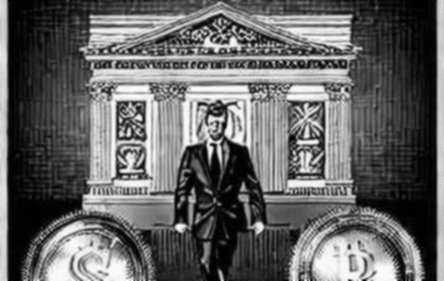
The SEC submitted a revised custody rule proposal to the White House on August 25. It is marked "economically significant" and designated as "deregulatory." That is not a typo.
Three years ago, the same agency, under Gary Gensler, tried to force digital asset custodians into a narrow box of banks, trust companies, and registered broker-dealers. The industry pushed back. The proposal collapsed. Now, under Paul Atkins, the SEC is moving in the opposite direction. It wants to strip out investor protection requirements that are no longer needed. My first reaction as a trader who has watched regulatory cycles turn capital flows: this is not about investor protection. This is about institutional access.
Let me be precise about what this means for the market, because the headlines will say "SEC eases crypto rules" and that is technically true but practically incomplete. The real story is about who gets to hold institutional money in crypto assets and under what technical standards.
The proposal targets the custody rules under the Investment Advisers Act of 1940 and the Investment Company Act of 1940. RIN 3235-AN46 is now in the hands of the Office of Information and Regulatory Affairs. Formal publication is targeted for October. This is early-stage rulemaking, but the direction is clear.
When I look at this through the lens of someone who has audited smart contracts and tracked liquidity flows, the technical implications are what matter. The 2023 proposal defined qualified custodians as a small set: state or federal banks, trust companies, SEC-registered broker-dealers, and CFTC-regulated futures commission merchants. That list excluded most crypto-native custody solutions. The new direction appears to widen that aperture.
Here is the part most commentary will miss: if the final rule allows non-traditional custodians, we are not just talking about compliance paperwork. We are talking about the technical architecture of asset safekeeping. Multi-party computation wallets, distributed validator technology, hardware security modules, and audited self-custody frameworks could all enter the compliance envelope. That changes the competitive landscape for custody infrastructure providers.
I have spent years watching how regulatory shifts alter market microstructure. When the SEC opened the door to Bitcoin ETFs in early 2024, I identified a persistent basis trade between spot ETFs and perpetual futures. I allocated $50,000 and executed the hedge manually across two exchanges. The strategy yielded a steady 8% annualized return with minimal volatility. That experience taught me a simple lesson: regulatory clarity creates measurable, tradeable inefficiencies.
This proposal is the next chapter of that story.
The market has partially priced this in. Maybe 30-50%. Atkins' friendly posture is known. But the specific rule text is not. And the market is bad at pricing details. Sentiment is noise; liquidity is the signal. Right now, the signal is that institutional-grade custody capacity is expanding through a parallel channel anyway.
Consider the broader context. A wave of new federal trust bank charters has been approved. That is not an accident. The market found a path around the old regulatory bottleneck before the SEC even moved. This new proposal is the SEC catching up to reality, not leading it.
Here is the contrarian angle. The "deregulatory" label is a narrative, not a guarantee. The final rule may still include capital requirements, audit standards, or segregation rules that constrain who can qualify. The 2023 proposal failed because it was too restrictive. A 2025 proposal that is too loose could trigger legal challenges from consumer protection groups. The risk is a middle ground that satisfies no one and delays institutional participation for another cycle.
I do not predict the wave; I build the board. What I am watching is the sequencing. The SEC has RIN 3235-AN48 on the agenda to clarify broker-dealer crypto compliance. Tokenized securities innovation exemptions are still pending. These are not isolated actions. They form a coordinated push to integrate crypto assets into the traditional financial rail system. Custody is the foundation. Without compliant custody, institutional capital stays on the sidelines. With it, the entire upstream-downstream chain shifts.
The downstream effects are where the real money moves. Traditional finance institutions have the most to gain. Lower custody barriers mean banks and trust companies can offer digital asset services without building proprietary infrastructure from scratch. Exchanges benefit from increased institutional volume. Infrastructure providers benefit from standardized compliance requirements that favor audited, battle-tested solutions. DeFi benefits indirectly through compliant on-ramps.
But the market is already crowded with custody hopefuls. Coinbase Custody, BitGo, Fireblocks, and a dozen smaller players are positioning for this exact scenario. The winners will not be the ones with the best marketing. They will be the ones with the most transparent audit trails and the cleanest technical architecture. Trust the ledger, not the legend.
The timeline matters. Formal proposal in October. Public comment period after that. Final rule potentially in the first half of 2026. This is a 6-12 month trade, not a 6-12 day trade. The market will overreact to every headline between now and then. That is where the opportunity sits.
Sunk cost is the anchor that drowns traders alive. Do not anchor to the 2023 framework or the Gensler-era assumptions. This is a different regime with different mechanics. The question is not whether the SEC is friendly. The question is what the final rule text says about who qualifies as a qualified custodian and what technical standards they must meet.
I am not predicting the wave. I am building the board. The board here has three levels. Level one: the OIRA review completes without major modifications. Level two: the October proposal aligns with market expectations. Level three: the final rule includes enough flexibility for non-traditional custody models. If all three hit, the custody sector reprices. If any one fails, the market corrects.
Here is what I am actually doing. I am monitoring the OIRA docket for changes. I am tracking the public comment period for organized opposition. I am watching whether the tokenized securities exemption moves in parallel. These are concrete signals, not vibes. They will tell me more than any analyst opinion or Twitter thread.
The SEC has submitted its proposal. The direction is clear. The details are not. That gap between direction and detail is where risk lives and where returns hide. The market will eventually price this correctly. The question is whether you have positioned yourself before the repricing happens.
The exit is the entry. Plan accordingly.